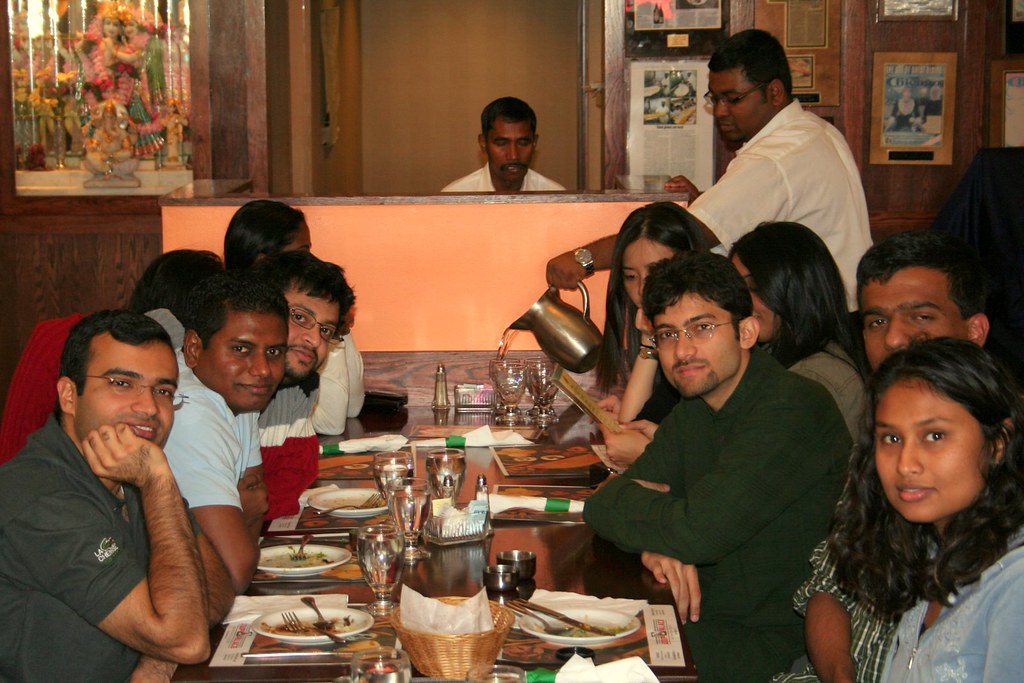
Prompted by a question from Tamasha on the other thread, about how I choose from among a range of possible ethnic and cultural identifiers, I wanted to write a post about the anthropological theory of situational ethnicity, and more generally about identity being the product not only of ascribed traits but also, and at the same time, of a strategic response to opportunities and constraints. Unfortunately I will have to save this for later, as all my relevant books are in a box in a storage space somewhere, and the good stuff online is all restricted to academic subscribers. I’ll get to it at some point, I promise. Every time we go down this path of endless disputes over how we do/can/should identify ourselves, I realize that this concept of situational identities is one of the most important and useful things that I learned in college and grad school.
However, in the course of ferreting about on Wikipedia and other places, I found another approach to ethnicity that is quite the opposite. It is the effort to code ethnicity by ancestry with maximum precision and detail, as evinced in the census and other official exercises in the United Kingdom. The 2001 UK census lists a variety of possible ethnic identifications that goes well beyond the selection offered in the United States. And the UK police forces are using a similar classification in their efforts to monitor crime and police response according to the ethnic background of the people they encounter.
Thus I learned that in the UK, I would be considered an M3, whereas most of you macacas are A1, A2 or A3. Here is the full range (from the PDF document linked here, page 76):
Asian or Asian British (A)
A1 Indian
A2 Pakistani
A3 Bangladeshi
A9 Any other Asian background
Black or Black British (B)
B1 Caribbean
B2 African
B9 Any other Black background
Chinese or Other Ethnic Group (O)
O1 Chinese
O9 Any other ethnic group
Mixed (M)
M1 White and Black Caribbean
M2 White and Black African
M3 White and Asian
M9 Any other mixed background
White (W)
W1 British
W2 Irish
W9 Any other White Background
This system is known as 16 + 1, for the 16 self-identified categories above plus an additional one, NS or “Not Stated,”
when an “individual chooses not to acknowledge their ethnic background. If this is the case the officer will assume their ethnicity and record this instead.”[Link]
The United States has its own tangled way of classifying, as anyone who’s had to fill a US census form knows. What is interesting is that the US still uses the term “race” where the UK uses the term “ethnicity.” This results in the perpetuation, here in the US, of a conflation between race and ethnicity that in turn fosters some of the confusion and misunderstandings that we encounter so much in our own conversations on this site. For all its bureaucratic stiltedness, I find the UK approach to be more helpful in actually capturing the diversity of a population, even if my personal instinct would be in most cases to avoid placing myself in any category… except when it is strategic to do so. Continue reading
 Who cares if there is no stamp commemorating Diwali when NBC’s Emmy Award winning comedy