Guest blogger: Ads

I met a fit (and you’ll know it), witty blogger at our fantastic SF Meetup this summer and I was immediately smitten like a kitten. She played it cool though, observing all the shenanigans around her while remaining slightly apart from the hoi polloi, a sphinx in our midst with an inscrutable smile. Either that or she was bored. Or pissed that I made her leave the east bay for North Beach.

No matter. Next to her, I was tigger, bouncing about, pouncing on Oms and Vinods alike, leaving glitter on everyone who had the misfortune of being accosted by a squealing, hugging, air kissing, scenery-masticator. Leaving the Meetup was like walking out of Scores après-laptease, you were marked by the shimmer of this social beast.

Not her, though. I didnÂ’t dare sully her hipper-than-thou, old skool track jacket, nor did I ever notice the omniscient eyes behind her alternagirl specs change their appraising gaze. Who was this woman? What was she considering so carefully as she observed the dozen desis around her? Where did she get that outfit? I wanted her. To tell me, I mean. 😉

I always get what I want (even when itÂ’s so late in the game, I no longer want it, but thatÂ’s not the case here so letÂ’s cut the parenthetical chitchat, shall we?)

Meet our next guestblogger, Ads. SheÂ’s a Buddhist guitarist, a left-coast dwelling east-coaster, an all-around original who remains anonymous, because you would all stalk her if you could (you know you would).

Sigh. I havenÂ’t had a pledge to haze since college (Cicatrix wasnÂ’t interested in getting paddled by ME). It feels ridiculously good to be someone’s akka again.

Now. Just because I

  • make her do flatliner shots whenever she forgets to state everything in the form of a question
  • lie to Abhi about how she’s a Creationist so he’ll follow/berate her
  • wake her in the middle of the night via airhorn
  • lock her in the freezer for kicks
  • force her to answer Ennis’ fanmail
  • have her pick the lint off all the teeshirts in the store room
  • order her to Trader Joe’s to fetch my preferred brand of 1% milk

or otherwise torture her doesn’t mean you are allowed to do so– be good to her or feel the wrath of my stiletto heels. And no, you won’t enjoy it. Ladies and Gentlemen, straight out of a very small and uncomfortable spot in the North Dakota bunker– Ads!

Continue reading

Boo shankar

Just in time for All Hallows Eve, here’s the story of an unnaturally thin Indian man who makes a living playing a ghost (via Boing Boing). He weighs just 52 pounds — if there’s an Adnan Sami in this world, there must be a Gopal Haldar:

Measuring a mere 1.21 meters (four feet) and weighing a slight 24 kilograms (52 pound), Haldar — now near to retirement age — says he has been malnourished all his life… He says it takes him only 10 to 15 minutes to do his makeup and transform his emaciated self into a ghost-like creature — mainly by painting his sunken face, protruding ribs and skeletal limbs with soot…

A doctor at a local government-run hospital said Haldar had likely suffered acute malnutrition as a child which had resulted in hormonal imbalances. [Link]

The man from the psychedelic jungles of the Sundarbans carries on a proud carnie tradition with his herbivorous habits:

He mainly does his shows during the festive seasons and earns 40 to 50 rupees (about a dollar) a time, said his wife Malati, adding resignedly, “But he is addicted to smoking hemp and spends all his money on this habit.” Lighting up a hemp cigarette in front of his wife, Haldar acknowledged his love of the herb. [Link]

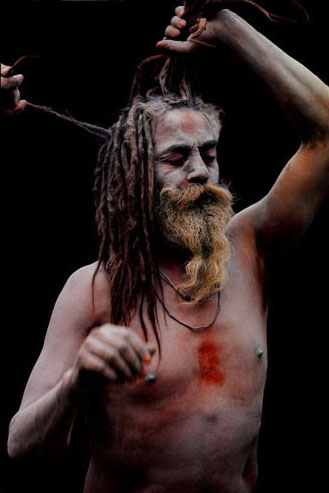
Emaciated, smeared in ashes and tolerant of chemical penances — is he a spook, or is he a Shaivite sadhu?

Continue reading

Salsa Diplomacy

Most have heard the old adage that no two countries that have a McDonald’s have ever fought a war against each other.

In his book, The Lexus and the Olive Tree, Thomas L. Friedman proposed The Golden Arches Theory of Conflict Prevention, observing that no two countries with a McDonald’s franchise had ever gone to war with one another, a version of the democratic peace theory. Shortly after the book was published, the NATO bombing of Serbia proved an exception to the theory, though in a later edition Friedman argued that this exception proved the rule: the war ended quickly, he argued, partly because the Serbian population did not want to lose their place in a global system “symbolised by McDonald’s” (Friedman 2000: 252-253). [Link]

A reporter from the Christian Science Monitor asks, “Why not Salsa?”  Once those hip start swinging who would want to fight?

What if it could be proved that no two nations that play salsa music have ever declared war on each other?

Some of the best salsa music in the Middle East comes from Egypt and Israel, for instance. Both nations have been at peace since 1979, the same period when salsa began to take hold.

The first time I heard Arabic salsa music, I was in a taxi in Dubai, United Arab Emirates, racing to catch a connecting flight to Afghanistan. The taxi driver, a Pakistani, was playing an incredible song on his radio. First came the Latin rhythms on bongos, then the rush of flamenco guitars. It sounded like the sort of dance music I grew up listening to in south Texas but with a distinctly Middle Eastern trill of the voice and the guttural lyrics that could only be Arabic.

Continue reading

I’m not from around here

This billboard of TMBWITW sits at the corner of Dundas and Yonge St. in downtown Toronto. Ironically, I was in that city attending the wedding of a man who’s infamous because of the same kind of billboard.

My buddy ‘Milind Das’ (not his real name, for reasons which will become clear) is a Canadian-born desi living in London. He used to work in India as a toney management consultant with an expat package. He often flew between Delhi and Bombay for business meetings at dawn. Early one morning, before sunrise, Milind witnessed an ethereal phantom in a white sari emerging from the fog at Indira Gandhi International. She was a young woman with large eyes, pleasant-looking but not overpoweringly so. She’d covered her hair and much of her face with the end of her sari and was accompanied by an elderly, glowering Cerberus.

Milind settled into his first class seat, pulled out his laptop and began working on a spreadsheet. The watchdog positioned herself grimly between him and her ward. Over the next two hours, her expression changed. At first it was, ‘Don’t even think about talking to my daughter.’ As the minutes ticked by and Milind remained oblivious to her beauty, it became, ‘Why the hell aren’t you talking to my daughter?’

Milind noticed the flight attendants were especially attentive that morning. When the flight ended, he shared a ride into town with one of the attendants whom he’d befriended. (Modesty forbids us from asking about that tale.) She asked him excitedly whether he’d seen the actress.

‘What actress?’

At that very instant, the cab was passing below a supersized Bollywood billboard. The aeronymph stared at him incredulously and pointed up in the air. And that’s how our young swain met The (Second) Most Beautiful Woman in the World.

I trust it’s clear why we must mask Milind’s identity. Otherwise, half a billion desi men would hunt him down for his Bolly ignorance. Of course, he found his own TMBWITW and, 96 hours ago, married her. I’m happy to report that ‘Mrs. Das’ lives up to the name.

Related post here.

Continue reading

Cabbie hartal in Naya York

NYC cabbies, the majority of whom are probably desi, threatened to strike over rising gas prices and GPS tracking at a rally on Monday:

Both groups claim drivers are paying upwards of $20 more per day for fuel. Drivers at the rally, who called yesterday for the ouster of TLC chairman Matthew W. Daus, complain that the spike in gasoline prices have chipped at savings and forced delayed vacations… “We want to be prudent,” Daus said. “These guys just got a fare increase — the biggest ever… They’re still making a lot more money based upon our data than before the fare increase.”

In one positive sign for advocates of the surcharge, Daus said he has talked with representatives from several cities where fares are tied to gas prices. [Link]

You run into this problem regularly with government-mandated price caps — the price doesn’t keep pace with real-world costs, and you’re stuck waiting for slow bureaucrats to recognize the new cost structure. A dynamic fare component which tracks fuel prices is an obvious solution.

Drivers wanted
[GPS tracking] eliminated, charging it would be used to track Muslims
But the more interesting complaint is about mandatory GPS tracking:

Drivers say they don’t want to be tracked and do not need the expense (estimates range from $3,000 to $5,000 per vehicle) of installation. They also claim the devices could be used to monitor speeding and other activities, violating their rights… The commission maintains that the tracking equipment would help drivers navigate traffic, provide efficient routes, and help passengers recover lost property. [Link]

… representatives of the New York Taxi Workers’ Alliance, a union of more than 6,500 New York taxi drivers, decried the monitors as a tool for the state to spy on them… [Link]

… drivers also wanted the GPS plan eliminated, charging it would be used to track Muslims, [Bhairavi] Desai said. [Link – PDF]

Continue reading

Tee party


You can finally buy Sepia tees and hoodies. Also check out the funny desi designs in the second half of the store.

You’re welcome to post design or color requests here, but please send any questions about the underlying shirts or order status to Spreadshirt. They use Fruit of the Loom, American Apparel and Hanes tees. A tip on ordering: the designs called ‘flex print’ are the most durable. The other designs eventually fade with repeated washing.

We make $5 per tee to help pay for blog hosting. If anyone’s ordered from Spreadshirt before, please let us know how the t-shirts turned out.

Here’s the store.

Continue reading

My first Ramadan

Amman, JordonSunset today marked the beginning of Ramadan for millions of Muslims around the world.

Muslims believe that during the month of Ramadan, Allah revealed the first verses of the Qur’an, the holy book of Islam. Around 610 A.D., a caravan trader named Muhammad took to wandering the desert near Mecca (in today’s Saudi Arabia) while thinking about his faith. One night a voice called to him from the night sky. It was the angel Gabriel, who told Muhammad he had been chosen to receive the word of Allah. In the days that followed, Muhammad found himself speaking the verses that would be transcribed as the Qur’an.

At many mosques during Ramadan, about one thirtieth of the Qur’an is recited each night in prayers known as tarawih. In this way, by the end of the month the complete scripture will have been recited.

Muslims practice sawm, or fasting, for the entire month of Ramadan. This means that they may eat or drink nothing, including water, while the sun shines. Fasting is one of the Five Pillars (duties) of Islam. As with other Islamic duties, all able Muslims take part in sawm from about age twelve. [Link]

I thought that I would share the story of my first Ramadan to mark the occasion here on SM. To me Ramadan was nothing but a word and a vague concept until three years ago.  I had read about it in books and had Muslim friends explain some of the traditions to me, but as a non-Muslim, unless you live in a Muslim country or near Detroit, I think it is difficult to really understand the feeling of Ramadan.  In November of three years ago I landed in Amman, Jordan just hours before sunset on the first full day of the holy month.  I had never stepped foot off a plane in an Islamic country before and I was excited to begin my adventure, in addition to being a bit nervous.  My destination lay approximately three hours south near the ancient ruins of Petra.  I stepped outside and looked for a cabbie that could speak some English.  I asked him if he could drive me to south to Petra.

“Sure.  You go Petra?  I take you.  Please sir. Come.”

Continue reading

The Bugs Tell The Story

A fascinating article from a science blog I read from time to time – 

This year’s Nobel Prize in medicine or physiology was announced this morning. Barry Marshall and J. Robin Warren won for discovering that ulcers can be caused not by stress or genes but by a bacterium called Helicobacter pylori (shown here)

…Helicobacter infects half of all people on Earth…The scientists documented a surprising variety of genes in the bacteria. Each ethnic group they looked at carried a distinctive strain.

As scientists got to know the global variation of Helicobacter better, they began to discover a remarkable pattern. They mapped out an evolutionary tree of the strains of the bacteria and found that it lined up very well with the migrations of humans over the past 50,000 years. One study looked at the Ladakh province of northern India. Muslims and Buddhists have coexisted there for 1000 [years] but remain isolated from one another. It turns out that Muslim Ladakhs only carry a European strain of Helicobacter, while Buddhists carry a mix of European and East Asian bugs.

They might be neighbors, but that don’t mean they’re friends.

Continue reading

The milk of Paradise

And from this chasm, with ceaseless turmoil seething,
As if this earth in fast thick pants were breathing,
A mighty fountain momently was forced:
Amid whose swift half-intermitted burst
Huge fragments vaulted like rebounding hail,
Or chaffy grain beneath the thresher’s flail…
And ‘mid this tumult Kubla heard from far
Ancestral voices prophesying war! …

I would build that dome in air…
And all should cry, Beware! Beware! …
And close your eyes with holy dread,
For he on honey-dew hath fed,
And drunk the milk of Paradise.

— Samuel Coleridge, ‘Kubla Khan

The Atlantic’s November issue has an excellent article on Abdul Quadeer Khan, the fat man behind Pakistan’s Little Boy. It’s the first in a two-part series about how Khan stole nuclear plans and procurement lists from a nuke lab in the Netherlands and turned funding from Pakistan, Libya and Saudi Arabia into a nuclear arsenal.

‘If your forces cross our borders… we are going to annihilate your cities.’

— Zia to Rajiv
The full text isn’t online, so here are some key bits:

Khan had become something of a demigod in Pakistan, with a public reputation second only to that of the nation’s founder, Muhammad Ali Jinnah, and he had developed an ego to match. He was the head of a government facility named after him–the Khan Research Laboratories, or KRL–which had mastered the difficult process of producing highly enriched uranium, the fissionable material necessary for Pakistan’s weapons, and was also involved in the design of the warheads and the missiles to deliver them… A. Q. Khan was seen to have assured the nation’s survival, and indeed he probably has–up until the moment, someday in a conceivable future, when a nuclear exchange actually occurs. [Link]

Continue reading

Bhutan’s Gross National Happiness

Many countries look at their Gross Domestic Product (GDP) as a measure of how strong their economy is and whether it’s expanding or contracting, but also to give an idea as to the standard of living in the country:

GDP is defined as the total value of final goods and services produced within a territory during a specified period (or, if not specified, annually, so that “the UK GDP” is the UK’s annual product). GDP differs from gross national product (GNP) in excluding inter-country income transfers, in effect attributing to a territory the product generated within it rather than the incomes received in it…

The most common approach to measuring and understanding GDP is the expenditure method:

GDP = consumption + investment + exports – imports… [Link]

Blah Bla Bla Blah Blah.  I’m not freakin’ Alan Greenspan and I’ve never taken an economics course in my life.  What else you got?  The New York Times reports on Bhutan’s economic indicator of choice.  It is a measure that in my opinion is ready for export.  The GNH, or Gross National Happiness:

What is happiness? In the United States and in many other industrialized countries, it is often equated with money.

Economists measure consumer confidence on the assumption that the resulting figure says something about progress and public welfare. The gross domestic product, or G.D.P., is routinely used as shorthand for the well-being of a nation.

But the small Himalayan kingdom of Bhutan has been trying out a different idea.

In 1972, concerned about the problems afflicting other developing countries that focused only on economic growth, Bhutan’s newly crowned leader, King Jigme Singye Wangchuck, decided to make his nation’s priority not its G.D.P. but its G.N.H., or gross national happiness.

Bhutan, the king said, needed to ensure that prosperity was shared across society and that it was balanced against preserving cultural traditions, protecting the environment and maintaining a responsive government. The king, now 49, has been instituting policies aimed at accomplishing these goals.

Their economic theory isn’t that far out is it?  I am not naive enough to think that they’ll get the prize later this week and am not ready to declare that I am moving to Bhutan, but why not consider the merits of this idea?  Every economic statistic thrown at you about a given country might tell you that the population as a whole is becoming wealthier.  That doesn’t mean that the lives of individuals are any better in terms of quality or happiness does it?

Continue reading