Flimflam man sells Indian PM’s home

A businessman forks over a small fortune for a house and ends up with nothing. It’s almost like the real estate market in California:

India’s intelligence department is investigating reports that a fraudster sold an American businessman the prime minister’s residence in the heart of New Delhi recently…and arrived in the Indian capital late in March to take possession of the house for an office he planned to set up only to discover he had been cheated. [Reuters/Yahoo!]

Reuters/Yahoo!: Fraudster sells Indian PM’s residence on web site

Continue reading

The thappad heard around the world

An Indian-American actress without an accent slaps comedian Steve Carrell in an episode of The Office called ‘Diversity Day’ (thanks, Amardeep). Pop Matters explains:

Michael… goads… a bewildered Indian employee with an outrageously offensive imitation of an Indian convenience store manager [and] earns a hard slap for his trouble…

Watch the clip (18 MB; you need a BitTorrent downloader: Windows, Mac). The thappad is at 1:37 in the clip.

Here’s Apul’s post on another funny incident in the same episode.

Arvin Sharma’s body found

A tragic end to the Arvin Sharma search (thanks, SadNepali):

D.C. police say the body of 22-year-old Arvin Sharma was pulled out of the Anacostia River. A passer-by saw a body near the 11th Street Bridge and called police at around 9:45 a.m. this morning. [WJLA]

60 Minutes covered the Anacostia River just yesterday, calling it a dividing line between the Capitol and one of the most dangerous neighborhoods in America:

Police say that so far this year, more than half the murders in Washington were committed here… Anacostia is a neighborhood where unemployment is epidemic and 38 percent of its residents live below the poverty line. [60 Minutes]

The search had been quite intense:

Ashish, Arvin’s 27-year-old brother and roommate, is taking time off work, and the university is spreading the word of Arvin’s disappearance. An aunt is making a trip from Thailand to provide support… “[The family] is taking care of the small things for us,” said Ashish Sharma. “Anyone we call is willing to jump on a plane.”

Arvin Sharma’s younger brother and friends have plastered areas with posters where Arvin might have been seen. “Everyone has been flooding the area with new fliers … Metro stops, gas stations, all the D.C. universities — Georgetown, George Washington and even Howard and Morgan State,” Ashish said. [UMD Diamondback]

Brimful of Amrit

Amrit Singh, the daughter of the Indian prime minister who’s a staff attorney for the ACLU, was interviewed today on a Chicago public radio station about the torture of U.S. detainees in Abu Ghraib and Guantánamo Bay (thanks, KXB).

Listen to the program. Here’s the program’s home page.

Update: Singh summarized the status of the ACLU’s torture lawsuits on the first anniversary of the Abu Ghraib photos. She said the ACLU is suing Donald Rumsfeld as an individual, so the lawsuit continues even after he’s no longer Secretary of Defense. That’s quite an aggressive tactic.

Singh was well-spoken with nary a stumble. Her accent was light, although she stressed the first syllable of ‘rapport.’

Previous posts: 1, 2

Continue reading

Joe Drug Addict

Sham marriages with a twist: a London scammer, Jaswinder Gill, was convicted of recruiting female British drug addicts to serve as fake brides (thanks, Sapna):

A woman who is thought to have made up to £1m out of a sham marriage empire has been jailed for 10 years… she told some of the young girls they would work in India as models or in the beauty trade, soliciting for business by handing out cards at London shopping centres… The court was told the women were described as “vulnerable” with at least two of them drug addicts.

One woman was flown to the subcontinent for what she thought was a photo shot. It turned out the “elaborate set” was a proper ceremony which ended with her married to a complete stranger. She was then abandoned to find her own way home. Another who tried to back out at the last minute was threatened with violence and warned she would be raped if she did not go through with it.

… “These marriages were a charade – arranged between perfect strangers who were coached by Gill to convince registrars of their intentions to live as man and wife in the UK.”

Methinks this would make a great Fox show, Who Wants to Marry a Drug Addict? Smile for the camera, honey! You may now kiss your cellmate.

Kama Sutra to prevent STD’s?

According to a short audio clip on NPR’s Weekend Edition, the Indian government has authorized Kama Sutra playing cards to be distributed in order to promote monogamy and prevent sexually transmitted diseases. To understand the logic of this you can listen to NPR’s clip (with “exotic” music in the background). However, I think NPR may have made a reporting error. First of all this idea isn’t new. The BBC reported on the use of Kama Sutra to prevent STDs (although by different reasoning) two years ago, pointing to a program in Calcutta.

The government in India’s West Bengal State is supporting a programme that offers prostitutes an ancient solution to modern concerns about safe sex.

“Kama Sutra has many postures that can give men the highest pleasure without consummation and that is what the prostitutes are being taught.

“They are learning something very useful,” says Rajyashree Choudhuri, chief of the Institute of International Social Development (IISD), who designed the project.

Furthermore a 1993 journal abstract in Global AIDS News mentions the following:

…the Indian Health Organization, a nongovernmental organization founded 11 years ago in Bombay, is promoting the teachings of the Kama Sutra as an alternative to condom use in preventing HIV/AIDS and other sexually transmitted diseases. The basic message that sex with one partner in many positions is safer than sex in one position with many partners is proclaimed on T-shirts and in a series of explicit postcards. This approach is promoting openness, communication, and equality between the sexes.

I’d pay BIG money for one of those T-shirts. Getting back to my point however, I think NPR mistakenly believed that the Indian Health Organization, which it mentions in the audio clip, is a branch of the Indian government and that this is a state sponsored national program. I don’t think the Indian government would be passing out Kama Sutra cards nationally. Am I wrong? If so, someone in India please correct me (and send me a deck of those cards…for reporting purposes). Continue reading

Tharoor, not Kidman, is the Interpreter

Director Sydney Pollack’s new film The Interpreter, which opened this weekend, is the first film ever to be allowed access to the halls of the United Nations in New York. The film stars Nicole Kidman’s character who, while performing her job as an interpreter for a fictional African nation, overhears a murder plot. The current United Nations Secretary General Kofi Annan, like his predecessors, was very sensitive about the image of the U.N. and wanted to make sure it was portrayed in a positive light and not maligned. He therefore appointed his trusted deputy, and author, Shashi Tharoor to interpret the script (and modify it if necessary). Rediff.com reports:

…Pollack could not take a no: the script demanded that much of film had to be shot inside the UN. He must have been aware that recreating the interiors of UN on a soundstage would cost nothing less than $5 million. And for a film budgeted at about $50 million, it would have been a burden.

‘I started calling anybody and everybody that I knew who had any connections and eventually, I was able to arrange a meeting with (UN Secretary General) Kofi Annan,’ he recalls in the production notes of the movie that opens on April 22.

The film has already opened in a handful of countries including Britain, Spain and Australia where it is shaping into a sizeable hit.

Pollack says he had no idea that the key to arranging the make-or-break meeting would be the novelist and movie buff Shashi Tharoor, who is also the under secretary-general for communications and public information at the UN. Tharoor was at once sympathetic to Pollack.

Tharoor says he felt the ban was ‘not terribly wise.’ The UN ‘is an institution we need to demystify a little bit,’ he says in the production notes. ‘We are an organisation of governments but we work for the peoples of the world, and I think it is important to make the UN more accessible to those people.’

Before Annan gave his approval, he asked Tharoor to consult the heads of the General Assembly and Security Council. Once they gave their assent, Pollack received the first-ever access to shoot at the General Assembly and other UN interiors. The Interpreter then became the first film to be shot inside the UN buildings, which are over five decades old.

An NPR interview with Pollack where he discusses the approval process and Tharoor’s involvement can be found here. Continue reading

Medical tourism on ‘60 Minutes’

Tonight, 60 Minutes showed medical tourists getting treatment at sleek new hospitals in Thailand and India. By showcasing ordinary Americans, the segment amounted to a giant infomercial for this practice. It’s especially salient given 60 Minutes’ demographic, older folks who are significant consumers of health care.

Download the video (49 MB; you need a BitTorrent downloader: Windows, Mac).

The Thai hospital they showed is designed like a hotel, with restaurants and boutique shops in the lobby. They also showed better treatment in India than in the U.S.: an advanced procedure, hip resurfacing, which is not yet available in the U.S.; a high ratio of nurses to patients; personal service; post-op recuperation at nearby resorts; and all for a tenth of the cost. A British medical tourist said that in the UK’s national health system, some women are pressured to leave the hospital just five hours after delivering a baby. In India there was no such pressure. On the flip side, the show noted that suing for malpractice in Indian courts is quite difficult.

The segment also interviewed Indian doctors returned from practicing in the U.S. who say they make only a tenth the money they used to make. One was quite earnest in wanting to help people: he said in the U.S., there are 1,500-2,000 pediatric cardiologists, but in India there were only four. I’ve also heard similar reasoning from eye surgeons.

The more video clips of modern India’s islands of quality are shown, the more respect desis in America will receive. Conversely, desi American doctors will face the same cost competition from India on high-end procedures that desi American programmers do now.

Previous posts: 1, 2, 3, 4

Indian Superheroes (updated)

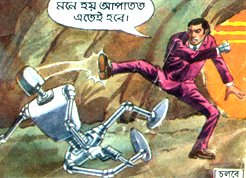
Amardeep directs our attention to the  Indian Superheroes page at the  International Catalogue of Superheroes. While it’s no Museum of Black Superheroes, it goes alot further than just Indian Superman and the new Spiderman.   Among my favorites were Koushik, a cyborg spy working for “Research & Analytic Wing, the super-secret intelligence service of Indian Government.” What boy wouldn’t like a superhero like this:

During one mission, his right arm got severely injured and had to be amputated at the wrist. One genius scientist from the espionage service replaced it with a very special robotic arm. This robotic arm has many secret powers including being able to fire bullets (used as a gun in emergencies) and spraying paralyzing gas which can paralyze even an elephant for a few hours. It also has nails which he can extended out from the hand and use like claws. Those nails can also be shot at any object, like a double-edged knife. The arm can be used as a laser gun; has a hidden transmitter/receiver near the wrist; and is so flexible that when he wears a glove, nobody can make out that it is a robotic arm.

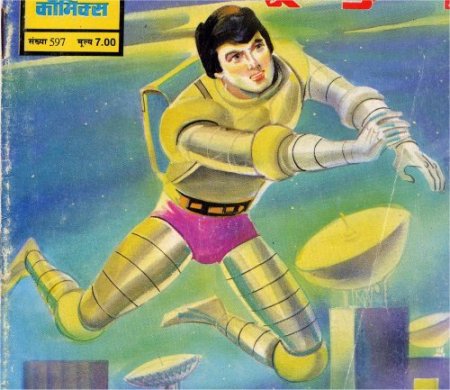
There is also Jumbu, about whom virtually nothing is known (Real Name: Unknown, Identity/Class: Unknown, Occupation: Unknown, Affiliations: Unknown, Enemies: Unknown, Known Relatives: None, Aliases: None, Base of Operations: Unknown, First Appearance: Unknown, Powers/Abilities: Unknown, History: Unknown) except that he is “One of the earliest Indian costumed superheroes.” What his constume is, exactly, is very hard to tell. I also don’t understand why he’s wearing his chuddies on the outside of his tin cans, except that this is what happens when you take fashion advice jointly from Superman and the Hulk.

UPDATE: Check out the other 21 superheroes listed at the Indian Superheroes page including Chacha Chaudhary, Chacha-Bhatija, and Supremo. [I should have mentioned Chacha Chaudhary, but had no interest in any of the live action superheroes being discussed.] You can also go straight to the Raj Comics and Diamond Comics websites. There you can indulge in your Chacha Chaudhary nostalgia for RS 15 per comic.

Continue reading