Bangladesh thrashes luxury goods

Bangladeshi customs officials have yet to discover the concept of a seizure auction:

Hundreds of people watched as officials from the National Board of Revenue (NBR) used bulldozers to crush a Mercedes Benz and a Toyota car and other luxury goods at a railway container terminal in Dhaka. NBR chairman Khairuzzaman Chowdhury said a trading firm had sought to evade customs duties by falsely declaring that the container carried iron scrap. "They wanted to befool us by saying they brought in scrapped metals…so we are giving them the same. They, or anyone like them, will not forget this," he told reporters at the site. [Reuters/Yahoo!]

Reuters/Yahoo!: Declaring cars as scrap? Dhaka customs makes it true

Update: BBC News has a small photo of the glorious event.

Continue reading

What lies beneath

Accents matter:

In a rambunctious Meatpacking District bar, I met a woman whose parents were German. She was tall, brown-haired and fair and had grown up in India. She had a Delhi accent.

At a self-storage business, I met a manager who looked black. He had a courtly manner and a delightful accent, and his nametag said Seetram (Sitaram). He was surprised and pleased when I guessed Guyanese.

In college, the hardest partier in the entire coed dorm was a girl from a wealthy Bombay family… She once told me, ‘English is my native language, yaar. I can hardly speak Hindi.’ She had that aggressive Bombay accent, the hard one used by young men on the make, not the singsong one nor the Marathi tapori…

In Barcelona, a middle-aged cab driver with a rich baritone guessed I was Latin American, narrowing it down to either México or Costa Rica. He was very good, because I had picked up my Spanish from a costarricense teacher in a California high school. In his mind, the Hindú bit was of least importance.

In 1993 I rode my motorcycle from San Francisco to Seattle and back, pausing overnight at a remote motel in Crescent City near the California-Oregon border. The motel owner was happy to hear Hindi. It’s a pity I didn’t have Gujarati in my repertoire for that extra discount.

Congratulations, [the talented] Mr. Rupinder. You’ve successfully passed just this once. But you’re only as good as your last con.

Continue reading…

Continue reading

Lassi

A non-desi former pastry chef has opened a restaurant in Greenwich Village which serves traditional dhaba food, lassi and paranthas (thanks, BridalBeer). The new place is called Lassi:

From delicate plate-dwarfing dosas at Hampton Chutney Co. and the N.Y. Dosa cart, to wraplike rolls at Roomali and the Kati Roll Co., to the colorful, crunchy chaat of Sukhadia’s Gokul, we’re undoubtedly having a Southeast Asian street-food moment…

I think they mean South Asian, but carry on:

Catchily named for the frothy yogurt drinks on offer in mango-flavored profusion all over town, Lassi is much more than an ethnic smoothie shop (though its premade featured beverages, in potent, refreshing flavors ranging from spice-flecked cardamom and vanilla to a complex and curdy lemon, can easily become an après-gym addiction).

… Lassi is bright and cheerful–like its owner, Heather Carlucci-Rodriguez, the former pastry chef of L’Impero and Veritas. A chance encounter with a Punjabi student in a pastry class she was teaching–and many stereotype-shattering home-cooked Indian meals– inspired Carlucci-Rodriguez to change culinary course. And even though she’s an unlikely Indian-restaurant owner, she’s a passionate one. Her food tastes unlike any other Indian in town–fresher, cleaner, but undiluted in its intricately spiced essence.

Continue reading

Torrent of Aishwarya Rai on ‘Oprah’

“The most beautiful woman in the world” takes on the most powerful woman in the world in an apocalyptic duel to the death on the “The Oprah Winfrey Show.” Download the entire sari-wrapping face-off:

“The Oprah Winfrey Show”: Aishwarya Rai (Quicktime, 11 MB, 11 mins.)
Requires a BitTorrent downloader — PC, Mac

Previous post: Not just a rumor anymore, Ash on Oprah this Monday

Continue reading

“like radioactive fallout in an arable field”

Perhaps to build enthusiasm for its annual book festival that took place this past weekend, The LA Times Op-ed section featured a moving ode to books (free registration required) by one Salman Rushdie (tip from Apul).

Books, since we are speaking of books, come into the world and change the lives of their authors for good or ill, and sometimes change the lives of their readers too. This change in the reader is a rare event. Mostly we read books and set them aside, or hurl them from us with great force, and pass on. Yet sometimes there is a small residue that has an effect. The reason for this is the always unexpected and unpredictable intervention of that rare and sneaky phenomenon, love. One may read and like or admire or respect a book and yet remain entirely unchanged by its contents, but love gets under one’s guard and shakes things up, for such is its sneaky nature. When a reader falls in love with a book, it leaves its essence inside him, like radioactive fallout in an arable field, and after that there are certain crops that will no longer grow in him, while other, stranger, more fantastic growths may occasionally be produced. We love relatively few books in our lives, and those books become parts of the way we see our lives; we read our lives through them, and their descriptions of the inner and outer worlds become mixed up with ours — they become ours.

That’s some deep stuff. Walking around the festival yesterday I stumbled across a modest line of people waiting for Chitra Banerjee Divakaruni to sign her book at the Artwallah table. Artwallah incidentally just released their book Shabash! which they refer to as “the hip guide to all things South Asian in North America.” The highlight of my day was when I made it over to listen to Jared Diamond speak about his book Collapse. Fascinating. Book festivals kick ass. Continue reading

The thappad heard around the world

An Indian-American actress without an accent slaps comedian Steve Carrell in an episode of The Office called ‘Diversity Day’ (thanks, Amardeep). Pop Matters explains:

Michael… goads… a bewildered Indian employee with an outrageously offensive imitation of an Indian convenience store manager [and] earns a hard slap for his trouble…

Watch the clip (18 MB; you need a BitTorrent downloader: Windows, Mac). The thappad is at 1:37 in the clip.

Here’s Apul’s post on another funny incident in the same episode.

Tharoor, not Kidman, is the Interpreter

Director Sydney Pollack’s new film The Interpreter, which opened this weekend, is the first film ever to be allowed access to the halls of the United Nations in New York. The film stars Nicole Kidman’s character who, while performing her job as an interpreter for a fictional African nation, overhears a murder plot. The current United Nations Secretary General Kofi Annan, like his predecessors, was very sensitive about the image of the U.N. and wanted to make sure it was portrayed in a positive light and not maligned. He therefore appointed his trusted deputy, and author, Shashi Tharoor to interpret the script (and modify it if necessary). Rediff.com reports:

…Pollack could not take a no: the script demanded that much of film had to be shot inside the UN. He must have been aware that recreating the interiors of UN on a soundstage would cost nothing less than $5 million. And for a film budgeted at about $50 million, it would have been a burden.

‘I started calling anybody and everybody that I knew who had any connections and eventually, I was able to arrange a meeting with (UN Secretary General) Kofi Annan,’ he recalls in the production notes of the movie that opens on April 22.

The film has already opened in a handful of countries including Britain, Spain and Australia where it is shaping into a sizeable hit.

Pollack says he had no idea that the key to arranging the make-or-break meeting would be the novelist and movie buff Shashi Tharoor, who is also the under secretary-general for communications and public information at the UN. Tharoor was at once sympathetic to Pollack.

Tharoor says he felt the ban was ‘not terribly wise.’ The UN ‘is an institution we need to demystify a little bit,’ he says in the production notes. ‘We are an organisation of governments but we work for the peoples of the world, and I think it is important to make the UN more accessible to those people.’

Before Annan gave his approval, he asked Tharoor to consult the heads of the General Assembly and Security Council. Once they gave their assent, Pollack received the first-ever access to shoot at the General Assembly and other UN interiors. The Interpreter then became the first film to be shot inside the UN buildings, which are over five decades old.

An NPR interview with Pollack where he discusses the approval process and Tharoor’s involvement can be found here. Continue reading

Medical tourism on ‘60 Minutes’

Tonight, 60 Minutes showed medical tourists getting treatment at sleek new hospitals in Thailand and India. By showcasing ordinary Americans, the segment amounted to a giant infomercial for this practice. It’s especially salient given 60 Minutes’ demographic, older folks who are significant consumers of health care.

Download the video (49 MB; you need a BitTorrent downloader: Windows, Mac).

The Thai hospital they showed is designed like a hotel, with restaurants and boutique shops in the lobby. They also showed better treatment in India than in the U.S.: an advanced procedure, hip resurfacing, which is not yet available in the U.S.; a high ratio of nurses to patients; personal service; post-op recuperation at nearby resorts; and all for a tenth of the cost. A British medical tourist said that in the UK’s national health system, some women are pressured to leave the hospital just five hours after delivering a baby. In India there was no such pressure. On the flip side, the show noted that suing for malpractice in Indian courts is quite difficult.

The segment also interviewed Indian doctors returned from practicing in the U.S. who say they make only a tenth the money they used to make. One was quite earnest in wanting to help people: he said in the U.S., there are 1,500-2,000 pediatric cardiologists, but in India there were only four. I’ve also heard similar reasoning from eye surgeons.

The more video clips of modern India’s islands of quality are shown, the more respect desis in America will receive. Conversely, desi American doctors will face the same cost competition from India on high-end procedures that desi American programmers do now.

Previous posts: 1, 2, 3, 4

Indian Superheroes (updated)

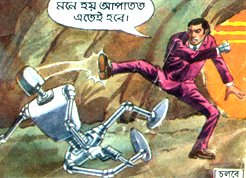
Amardeep directs our attention to the  Indian Superheroes page at the  International Catalogue of Superheroes. While it’s no Museum of Black Superheroes, it goes alot further than just Indian Superman and the new Spiderman.   Among my favorites were Koushik, a cyborg spy working for “Research & Analytic Wing, the super-secret intelligence service of Indian Government.” What boy wouldn’t like a superhero like this:

During one mission, his right arm got severely injured and had to be amputated at the wrist. One genius scientist from the espionage service replaced it with a very special robotic arm. This robotic arm has many secret powers including being able to fire bullets (used as a gun in emergencies) and spraying paralyzing gas which can paralyze even an elephant for a few hours. It also has nails which he can extended out from the hand and use like claws. Those nails can also be shot at any object, like a double-edged knife. The arm can be used as a laser gun; has a hidden transmitter/receiver near the wrist; and is so flexible that when he wears a glove, nobody can make out that it is a robotic arm.

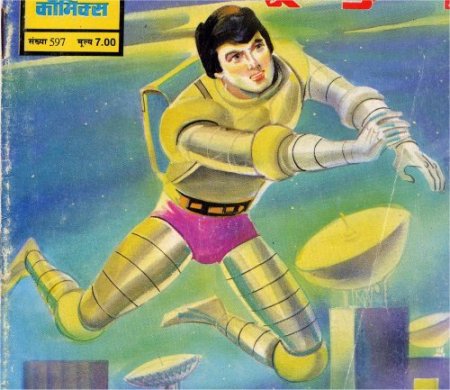
There is also Jumbu, about whom virtually nothing is known (Real Name: Unknown, Identity/Class: Unknown, Occupation: Unknown, Affiliations: Unknown, Enemies: Unknown, Known Relatives: None, Aliases: None, Base of Operations: Unknown, First Appearance: Unknown, Powers/Abilities: Unknown, History: Unknown) except that he is “One of the earliest Indian costumed superheroes.” What his constume is, exactly, is very hard to tell. I also don’t understand why he’s wearing his chuddies on the outside of his tin cans, except that this is what happens when you take fashion advice jointly from Superman and the Hulk.

UPDATE: Check out the other 21 superheroes listed at the Indian Superheroes page including Chacha Chaudhary, Chacha-Bhatija, and Supremo. [I should have mentioned Chacha Chaudhary, but had no interest in any of the live action superheroes being discussed.] You can also go straight to the Raj Comics and Diamond Comics websites. There you can indulge in your Chacha Chaudhary nostalgia for RS 15 per comic.

Continue reading